FDV Toolkit
Family and domestic violence toolkit
A resource for Community Housing Providers

Family and domestic violence toolkit
A resource for Community Housing Providers
This toolkit is to help educate and provide needed information about the reform to tenancy legislation regarding Family and Domestic Violence (FDV) to community housing providers in Western Australia. This toolkit will provide a range of materials and resources for community housing providers to draw from when faced with a situation which may involve the inclusion of family and domestic violence under the Residential Tenancies Act 1987.
The purpose of this toolkit is to provide information to community housing providers on the family and domestic violence reforms introduced to the Residential Tenancies Act 1987.
Family and domestic violence is a crime. It is behaviour that results in physical, sexual and/or psychological damage, forced isolation, economic deprivation, or causes the victim(s) to live in fear. It can be experienced by people of all classes, religions, ethnicity, ages, abilities and sexual preference.
Examples of criminal offences in family and domestic violence situations include physical, emotional, psychological and sexual assault. Family and domestic violence also includes actions like making threats to a person’s safety, stalking, damaging or stealing property, harming a person’s pet, breaching restraining orders and it extends to dominating, controlling, isolating and restricting the freedom of another person.
In many cases, the victim and the perpetrator may live together, however the perpetrator does not have to be living in the same house for the situation to qualify as family and domestic.
Physical abuse is any behaviour that is intended to cause harm including pushing, slapping, punching, choking, and kicking.
Sexual abuse is any forced sexual contact and activity. “Forced” in this context refers to individuals who are physically coerced to participate or who are not in a position to say no as a result of fear, threats, or intimidation.
Verbal abuse is any act which threats, insults, or denounces another person. Verbal abuse can be seen in the forms of shouting, belittling, swearing, and name calling.
Emotional abuse (also known as psychological abuse) is any act which undermines another person’s feelings. Emotional abuse can be in the form of mind games, manipulation, humiliation, and making the person feel worthless.
Financial abuse is any act that controls the money and decisions around its use. Financial abuse can be in the forms of taking, limiting/rationing, and stealing money. It can also be in the form of putting another person in debt and in financial stress.
Family and domestic violence is characterised by the pattern of actions that an individual use to intentionally control or dominate another person. For example, a perpetrator may systematically use threats, intimidation, and coercion to instil fear into their partner.
Being aware of such patterns of behaviour and actions may assist in better identifying the signs of family and domestic violence. If any of the following are happening in your community, then the affected person(s) may be a victim of family and domestic violence.
Tenancy termination due to FDV
A victim of family and domestic violence can terminate their interest in the tenancy by giving the lessor 7 days’ notice without financial or legal penalty. Learn more here.
Tenancy termination with co-tenants
If a victim of family and domestic violence terminates their interest in the tenancy which has co-tenants, the co-tenants may then choose whether or not to end their tenancy. Learn more here.
Removal of a perpetrator
If a victim of family and domestic violence continues their tenancy the court can terminate a perpetrator’s interest in the tenancy, enabling the victim to remain in the property. Learn more here.
Unpaid debt and liabilities
The court can assign liability for damages or unpaid rent arising as a result of family and domestic violence. Learn more here.
Bonds
After assigning liability for damages the court can apportion the security on the presumption that each tenant is entitled to an equal proportion of the security bond. Learn more here.
Changing the locks
A victim of family and domestic violence may change the locks without prior permission. Learn more here.
Altering the premises
A victim of family and domestic violence may affix prescribed fixtures and make prescribed renovations, alterations, or additions to increase security and safety. Learn more here.
Restraining order
An order for termination of a perpetrator’s interest in a tenancy can be made in proceedings for a restraining order. Learn more here.
Disputing the termination
Whether someone is experiencing family and domestic violence cannot be disputed. Only the court can decide whether the notice to terminate the tenancy was validly given. Learn more here.
Resolve
The court has the power to order removal of personal details from a Residential Tenancies Database (blacklist) where there is family and domestic violence.
Learn more here.
Western Australia has some of the worst rates of family and domestic violence (FDV) in Australia. There are tens of thousands of reported incidents of FDV every year and often the abuse, whether physical or psychological, occurs in rental homes.
Before the reform, in Western Australia, including the Indian Ocean Territories, a person who left a rental property at short notice because of FDV was legally required to pay rent until a new tenant was found or the agreement expired. This was costly and meant FDV victims, including children, either stayed in a violent home or risked becoming homeless.
The Residential Tenancies Act 1987 needed reform to provide options for tenants affected by family and domestic violence enabling them to decide whether to leave or stay on the property. These laws give new rights to tenants and obligate landlords with new responsibilities.
This legislation reform empowers victims, and gives the court, landlords and property managers tools to reduce the impact of family and domestic violence.
There are benefits to you, as a community housing provider, because a tenant affected by family and domestic violence will now have a legal way to leave a tenancy if they cannot safely remain.
Housing professionals have a key role to play, alongside their colleagues in social services, health and the police, in keeping people safe. Housing professionals are ideally placed to identify victims of family and domestic violence, but only if they know what to look for. Learn more about the signs of family and domestic violence here.
What community housing providers need to do and know when faced with a situation of FDV under the new reform.
Community Housing Providers can be faced with a number of different situations under the new previsions of family and domestic violence in the Residential Tenancies Act 1987. Under the new provisions a tenant experiencing family and domestic violence has options to stay, go, secure and resolve. These decisions mean new responsibilities for community housing providers.
When faced with a situation of family and domestic violence you, as a community housing provider, can determine what you need to do, what to expect and what your responsibilities are for each of the different situations. Below are each of the various situations of family and domestic violence under the new reform your organisation may face.
Community Housing Providers when faced with a situation of family and domestic violence which will change a tenancy agreement will always have one of three outcomes.
Opposite shows these options in a summary table.
If a tenant or a dependent of the tenant has been affected by family and domestic violence during the tenancy, they can give the community housing provider/property manager at least seven (7) days’ notice that they want or need to terminate their interest in the tenancy agreement and vacate with immediate effect.
For a tenant to terminate their tenancy agreement under the provisions of family and domestic violence they must provide you, the community housing provider, with a notice of termination and one evidence document of family and domestic violence.
Notice of Termination
A tenant must provide a notice of termination to end the tenancy on the grounds of family and domestic violence.
The notice of termination will be either a:
Click here for the notice of termination of tenant’s interest in residential tenancy agreement on grounds of family violence form.
Click here for the notice of termination of tenant’s interest in on-site agreement on the ground of family violence form.
Important Note
Make sure the tenant provides you with the correct notice of termination form. As a community housing provider you would most likely need to receive the Residential tenancy agreement for residential properties.
Evidence Document
The tenant must also provide one evidence document of family and domestic violence. An evidence document can be any one of the following:
The official Consumer Protection Family violence report – The evidence form must be signed by a designated professional. This professional can be any of the following:
Click here for the family violence report – evidence form.
The 7 Day Notice
As the community housing provider, you cannot challenge the tenant(s)’ request to break the agreement if the notice and supporting evidence have been completed properly and provided with at least seven (7) days’ notice. If the documents are not completed properly you can appeal the termination notice in court.
A lesson chart showing the counting days to when a tenant terminated their interest in a lease on the grounds of family and domestic violence can be found here.
Important Note:
A perpetrator does not have to be named on the lease for a tenant to submit the termination notice and evidence form.
If a notice of termination of tenant’s interest in residential tenancy agreement on grounds of family violence is issued then you, as the community housing provider, must provide a copy of the form (but not accompanying evidence) to any co-tenants and give them seven (7) days to decide if they want to continue with the tenancy agreement.
A family of three live in a community home together, Kate (Grandaughter aged 22), Josh (Grandson, aged 25), and Jenny (Grandmother, aged 74).
Kate is experiencing family and domestic violence from a past partner, and even though he is not a tenant Kate still fears for her safety as he knows where she lives. Kate decides to submit a notice of termination under the provisions of family and domestic to her community housing provider with the required evidence form. She provides the community housing providers 7 business days notice as she is meant to.
As Josh and Jenny are co-tenants the community housing provider also provided them a copy of the notice of termination, but does not provide the evidence form as this is confidential (See important note below). Josh decides he also wishes to leave the tenancy, giving the community housing provider 21 days notice. Jenny decides to stay so the community housing provider must allow her to remain in the tenancy, and Jenny now becomes the sole tenant in the tenancy agreement.
(Grandaughter, aged 22)
Terminates her interest in the tenancy under the provisions of FDV.
Leaves tenancy
(Grandson, aged 25)
As a co-tenant he chose to also leave the tenancy.
Leaves tenancy
(Grandmother, aged 74)
As a co-tenant she chose to stay in the tenancy.
Remains in tenancy
As the community housing provider, you must NOT disclose the evidence document to a co-tenant. Only a copy of the notice of termination should be provided to the co-tenant. A list on infringements community housing providers can incur can be found here.
A community housing provider is required to keep any FDV evidence (e.g. Consumer Protection family violence report – evidence form, copy of restraining order, family court order) you receive in a safe and secure manner. If the details are disclosed, for example to a co-tenant, you, as the community housing provider can be prosecuted.
If a perpetrator is named on the tenancy agreement and the victim tenant wants to stay, they can apply to the court, using a Residential Tenancies Form 12, to have the perpetrator removed from the agreement.
If a tenant asks you, as the community housing provider, how to remove a perpetrator from the tenancy agreement, direct them to complete Form 12 as supplied by the Department of Mines, Industry Regulation and Safety. The Residential Tenancies Form 12 can be found here and the PDF version can be found here.
After a tenant has applied to the court to have a perpetrator removed from the tenancy agreement using a Residential Tenancies Form 12, the court will notify the community housing provider and any co-tenants about the hearing via a notice from the court.
As the community housing provider, you are entitled to participate in the court proceedings. The court will send you, and any co-tenants, a copy of the court application and notice of any hearing.
A chart showing the counting days of the court ordering a termination of a perpetrator tenant’s interest in a lease on the grounds of family and domestic violence can be found here.
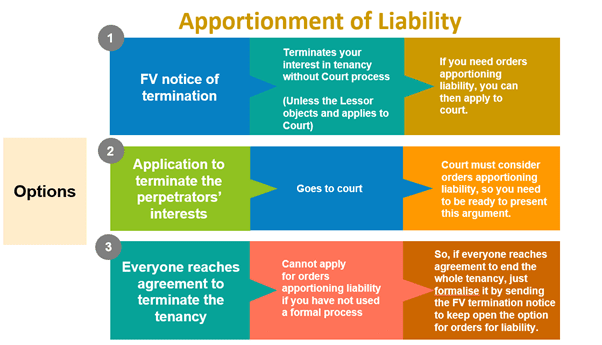
If there has been damage to the premises or unpaid rent as a result of family and domestic violence, the court can assign liability for any damages or debt to whoever is responsible for the family and domestic violence, i.e. the perpetrator.
For this to occur the tenant who is experiencing family and domestic violence, whether vacating the premises or staying, must apply to the court using the court order form 12. If you have a tenant ask you about seeking repayments for damages and unpaid rent from the perpetrator direct them to the court order form 12 FDV guide. A PDF copy of the court order form 12 can also be found here.
It is important to understand that if there is no court order, all the tenants on the tenancy agreement remain jointly liable for any damages and/or debts.
This provision can only be used if a tenant’s interest in the tenancy has been terminated due to FDV circumstances under sections 71AB, 71AD or 71AE. As the community housing provider, you mus receive the notice of termination and evidence form from the tenant.
The tenant can also follow the same procedure to make the perpetrator pay out some of the security bond. Learn more about what can happen to bonds under the provisions of family and domestic violence here.
This does not change how much you as a landlord can claim but clarifies who is responsible for the payment. Either a vacating or remaining tenant will need to apply for this court order. If there is no court order, all tenants remain jointly liable for any damages and/or debt.
Some insurance companies understand the impacts of family and domestic violence on the community and individuals. Be sure to contact your insurance provider to check your cover in relation to family ans domestic violence, as you may be able to claim defaulted rent and/or property damages. It is important to find our what your insurance provider will cover, what the eligibility criteria for FDV cover is and if there are any exclusions.
Just like the court can order a perpetrator to pay any debts or liabilities as a result of family and domestic violence, the court can make an order to pay out some of the security bond, in the instance of a tenancy being terminated under the provisions of family and domestic violence.
The court may order to pay out some of the bond too:
any tenant who is leaving the tenancy, if they do not owe the lessor/property manager any money; and/or
to you, as the community housing provider if you are owed money for any damages and debt.
This does not change how much you, as the community housing provider, can claim but clarifies who is responsible for the payment. Either a vacating or remaining tenant will need to apply for this court order. If there is no court order, all tenants remain jointly liable for any damages and/or debt.
If part of the security bond is paid out and the tenancy is ongoing, you, as the community housing provider, will be entitled to ask the remaining tenant(s) to top up the security bond to the maximum amount permitted under the Act. The Act does not set out a time frame in which the tenant is required to top up the bond.
However, you, as a community housing provider, is encouraged to be reasonable in negotiating the time frame with the remaining tenants.
If the tenant(s) refuse to top up the bond in the given/negotiated time frame you, as the community housing provider would treat this scenario like any other breach of the Act, issuing the remaining tenant with a Notice to Tenant of Breach of Agreement (Form 20). If the tenant continues to refuse to top up the bond, then you can issue a Notice of termination (Form 1C).
Some insurance companies understand the impacts of family and domestic violence on the community and individuals. Be sure to contact your insurance provider to check your cover in relation to family ans domestic violence, as you may be able to claim defaulted rent and/or property damages. It is important to find our what your insurance provider will cover, what the eligibility criteria for FDV cover is and if there are any exclusions.
Regarding bonds, its important o check your insurance policy will not be voided if the maximum bond amount permitted is not being held by the bond administrator.
Under the tenancy law changes, tenants can now change the locks on their home without first seeking their community housing provider’s permission.
Tenants are allows to change he locks either:
Changing a lock under the circumstances of family and domestic violence does not need to be evidenced and a community housing provider must not ask the tenant to evidence their experiences of family and domestic violence.
As a community housing provider, if you believe a tenant has changed a lock unlawfully, i.e. has changed a lock claiming FDV but is not experiencing FDV, then you will need to lodge a complaint with Consumer Protection. Consumer protection will then investigate if the tenant was impacted by family and domestic violence in order to determine if the locks were changed lawfully or not. Learn more about making a complaint to Consumer Protection here.
The tenant must give you a copy of the new key(s) within seven (7) days. Tenant must pay for the lock change (although it could be funded through a Safe at Home program) or, for Housing Authority tenants, the Government may pay). Community housing providers are welcome to offer to change the locks on the tenant’s behalf if that is an option.
If a tenant fails to give you, as the community housing provider (unless the community housing provider or an employee is the alleged perpetrator), a copy of the key within 7 days, this is classed as an offence under the Residential Tenancies Act 1987 which can result in the Department issuing an infringement Notice. Only a Court can issue the penalties listed in each Act, but where the Department believes there is sufficient basis for a belief that an offence was committed it may issue an Infringement Notice. Currently, the penalty is up to $1000 for failing to provide a copy of the key within 7 days.
The tenant must give you a copy of the new key(s) within seven (7) days. Tenant must pay for the lock change (although it could be funded through a Safe at Home program) or, for Housing Authority tenants, the Government may pay). Community housing providers are welcome to offer to change the locks on the tenant’s behalf if that is an option.
If a tenant fails to give you, as the community housing provider (unless the community housing provider or an employee is the alleged perpetrator), a copy of the key within 7 days, this is classed as an offence under the Residential Tenancies Act 1987 which can result in the Department issuing an infringement Notice. Only a Court can issue the penalties listed in each Act, but where the Department believes there is sufficient basis for a belief that an offence was committed it may issue an Infringement Notice. Currently, the penalty is up to $1000 for failing to provide a copy of the key within 7 days.
The community housing provider cannot give a copy of the key to someone previously listed on the tenancy agreement or to any person the tenant has specified in a provided written letter, as stated in the Act below. A lessor who breaches this provision without reasonable excuse is liable to a penalty of up to $2,000 (see section 59F(2A)).
Just like with changing the locks, the tenancy law changes also allows a tenant to make prescribed security upgrades to the premises without their community housing providers permission:
Whilst the tenant does not need permission to make changes, the tenant must inform you, as the community housing provider, about the changes prior to them happening. The tenant must also have the security upgrades be installed by a qualified trade person(s).
Any associated costs are the tenant’s responsibility but may be funded under a Safe at Home program. A copy of any settled invoice should be supplied to the landlord. All upgrades should comply with strata by-laws and take into consideration the age and character of the property.
At the end of the tenancy, you can ask the tenant to restore the rental property to its original condition. Alternatively, if you feel the upgrades add value to the home and you would like to leave them in place you could negotiate to pay an appropriate amount to the exiting tenant.
An Order for termination of a perpetrator’s interest in a tenancy can be made in proceedings for a restraining order, but an order removing a perpetrator from a tenancy or apportioning liability cannot be made at an ex-parte application for a restraining order.
If a tenant approaches you about needing a restraining order, direct them to the Magistrates Court to apply for a restraining order.
The Magistrates Court of Western Australia provides restraining order forms and information, which can be found here.
Below is the different types of restraining orders and where to go for more information.
A Family Violence Restraining Order (FVRO) is an order of the court designed to protect the safety of the person from abuse and violence from a family relationship. The person determined to pose a risk as a family relationship can be any person;
If you have a tenant express such a situation to you and they need more information on a VRO you can send them to the Magistrates Court website here or the Legal WA Aid website, here.
If you would like more information on a VRO you can view this PDF fact sheet produced by the Magistrates Court of Western Australia, here or the Legal Aid WA fact sheet, here.
A Conduct Agreement Order (CAO) is the name given to an FVRO that has been made with the consent of the Respondent (the Person Bound), without making any admissions. Essentially, a CAO when the Respondent (person whom the restraining order is against) consents to the FVRO on a without admissions basis. ‘Without admission’ means a party is not agreeing with any of the allegations made against them by the other party. This means the party does not agree that family violence occurred.
If you have a tenant express such a situation to you and they need to know more about a CAO you can send them to the Legal WA Aid website, here.
If you would like more information on a VRO you can view this PDF fact sheet produced by the Magistrates Court of Western Australia, here or the Legal Aid WA fact sheet, here.
A Violence Restraining Order (VRO) is an order of the court designed to promote the safety of the person/s protected by placing restrictions on the actions and behaviours of the person determined to pose a risk of future harm. The person determined to pose a risk is not a family relationship, i.e they could be a friend, work colleague, or neighbour.
If you have a tenant express such a situation to you and they need more information on a VRO you can send them to the Magistrates Court website here.
If you would like more information on a VRO you can view this PDF fact sheet produced by the Magistrates Court of Western Australia, here.
A Misconduct Restraining Order (MRO) is an order of the court to help prevent behaviour that may intimidate, damage property, or cause a breach of peace. The person determined to pose a risk is not a family relationship, i.e they could be a friend, work colleague, or neighbour.
If you have a tenant express such a situation to you and they need more information on a MRO you can send them to the Magistrates Court website here or the Legal Aid WA website, here.
If you would like more information on a MRO you can view this PDF fact sheet produced by the Magistrates Court of Western Australia, here or the Legal Aid WA fact sheet found here.
Police Orders are a special written form issued by a police officer to give temporary protection against the risk of family and domestic violence. A police order is issued when a police officer is investigating and responding to a situation involving family and domestic violence, whereby a police officer reasonably believes an FVRO could be made.
Typically, a police order lasts for 72 hours.
If you, as a community housing provider or a tenant needs more information on a Police Order visit the Legal Aid WA website here.
Family and domestic violence is often well hidden and can happen to anyone. Family and domestic violence can occur to any individual no matter their gender, age, ethnicity, religion, abilities, and sexual orientation.
As a community housing provider, you are not expected to be a professional on family and domestic violence. Hence, you can not determine if someone is experiencing family and domestic violence.
If you wish to dispute a notice of termination under the provisions of family and domestic violence it can not be on the basis of if family and domestic violence occured. You, as a community housing provider, can only dispute a notice of termination if the right notice was not given, i.e. given at least 7 days prior to the termination date, and attaching the right evidence.
If you do challenge the notice, you have 7 days from receiving it to apply to the court for a review under section 71AC. The court can only decide whether the notice was validly given. The court also cannot examine whether family and domestic violence occurred.
To learn more about how to apply to the court visit the Consumer Protection website, here.
As a community housing provider, you play a critical role to protect the community from family and domestic violence. If you have a tenant submit notice of termination on the ground of family and domestic violence, whereby the documents are not completed properly, you do not have to dispute the termination. It is encouraged that community housing providers cooperate with the tenant to enable them to provide the proper documentation. Helping and supporting a tenant who needs to leave their tenancy due to family and domestic violence is helping protect them.
Ultimately, you are helping to save lives of those experiencing family and domestic violence.
Implementing best practices and procedures helps ensure your organisation complies with mandatory legislated standards, such as the Residential Tenancies Act of 1987. Community housing providers can receive infringements for failing to meet their responsibilities and rights under the Residential Tenancies Act 1987, which can be found here. Alternatively, if a tenant fails to meet their responsibilities that can also receive infringements, which can be found here.
Below details some professional housing best practices and procedures community housing providers should consider implementing, if not already in place.
Possible signs of family and domestic violence which can be identified include:
Please refer to The Department of Communities website for possible supportive resources. You can access the site and search for what you need here.
Under the provisions of family and domestic violence community housing providers do have an important role to play and with this comes some key responsibilities, such as:
Ultimately, it is your responsibility, as a community housing provider, to ensure you comply to the Residential Tenancies Act 1987, including the new provisions for family and domestic violence.
However, Community Housing Providers are not expected to become experts in family and domestic violence.
The below checklist is for community housing providers and employees that provide a guide to maintaining a healthy and safe environment when managing potential scenarios of family and domestic violence.
Management Responsibilities
Note – This checklist is only a guide. You can compare this checklist to your existing policies and procedures to see if you may have any gaps. You may wish to change and adapt to suit your organisational needs.
The below checklist is for community housing staff to ensure they understand their responsibility and to provide a guide to maintaining a healthy and safe environment when faced with potential scenarios of family and domestic violence.
Note – This checklist is only a guide. You can compare this checklist to your existing policies and procedures to see if you may have any gaps. You may wish to change and adapt to suit your organisational needs.
Some people have shared their experiences of family and domestic violence.
Mick’s violent ex-partner was no longer living with him at the rental home they previously shared. However, she still had a key. She would enter the property when he wasn’t there and go through his things and also move items around.
Mick approached his property manager and asked to change the locks. He explained that his ex was “messing with his head” by re-entering the property and he didn’t feel safe. The property manager told Mick to “toughen up”.
Mick came to Consumer Protection and we negotiated with the property manager to ask the landlord if the locks could be changed for family violence reasons, especially in light of the new laws coming soon. Under the new laws Mick would not have to ask for permission to change the locks and would just need to provide a copy of the key to his property manager / landlord within seven (7) days.
Please note the individuals name has been changed to protect the person’s identity.
Megan and her partner James rented their home together and were both listed on the lease. After a series of violent life-threatening incidents Megan applied for a restraining order and sought support and advice from the local women’s refuge.
Megan contacted Tenancy WA because she really wanted to stay in her home and have James removed from the lease. James was fighting the restraining order and wouldn’t reply to any requests about changing the lease into Megan’s name. In addition, he was not paying any rent. Tenancy WA advised Megan about her options and supported her in negotiations with the landlord of the property.
Due to Western Australia having no specific provisions in the Residential Tenancies Act to deal with family and domestic violence situations at the time, there was no power for the Court to transfer a lease into one name.
Sarah was a refugee with limited understanding of English. Sarah’s ex-partner was financially dependent on Sarah and was abusive towards Sarah through their entire relationship, often threatening her life.
In September 2016, Sarah’s ex-partner assaulted her, resulting in concussion. Sarah fled the property and moved back in with her family, which was significantly overcrowded. Sarah’s daughter and Sarah’s six siblings all living in a three-bedroom property. Sarah continued to pay rent at the property through fear of her ex-partner returning and fear of being unable to rent again in the future.
The agency did not take any steps to re-let the property during this time and Sarah continued to pay for the property for 4 months until the matter was settled in Court.
Before the Residential Tenancies Act 2018 there is no established precedent or legislation about unilaterally terminating a fixed-term agreement where there is more than one signatory on the lease, particularly when there is domestic violence involved. When there is a Violence Restraining Order (VRO) in place, it makes it difficult for the tenant seeking termination to disclose information without breaching the VRO or putting themselves in danger.
Watch a video of Kate Davis, Principal Solicitor at community legal center Tenancy WA, explaining how the Western Australian tenancy law changes would have helped Sarah and how victims are now protected from unfair financial burdens and safety risks as a result of family and domestic violence.
What if I do not know the tenant is subjected to FDV?
This is not your judgement to make. If you have received the appropriate notice, in writing, at least 7 days prior to the date the tenant is ending the tenancy and the notice is accompanied by one of the documents listed as prescribed documents, you are required to follow the legal process for ending the tenancy.
How do I know if the tenant is subjected to FDV?
As a landlord, you do not need to make any judgement as to whether the tenant, or their dependent, is, or is likely to be, subjected or exposed to family violence, or whether it occurred in the property. You simply need to check you have received the appropriate notice, in writing, at least 7 days prior to the date the tenant is ending the tenancy and that the notice is accompanied by one of the documents listed above.
What if I do not know the tenant is subjected to FDV?
This is not your judgement to make. If you have received the appropriate notice, in writing, at least 7 days prior to the date the tenant is ending the tenancy and the notice is accompanied by one of the documents listed as prescribed documents, you are required to follow the legal process for ending the tenancy.
How do I know if the tenant is subjected to FDV?
As a landlord, you do not need to make any judgement as to whether the tenant, or their dependent, is, or is likely to be, subjected or exposed to family violence, or whether it occurred in the property. You simply need to check you have received the appropriate notice, in writing, at least 7 days prior to the date the tenant is ending the tenancy and that the notice is accompanied by one of the documents listed above.
What if I do not know the tenant is subjected to FDV?
This is not your judgement to make. If you have received the appropriate notice, in writing, at least 7 days prior to the date the tenant is ending the tenancy and the notice is accompanied by one of the documents listed as prescribed documents, you are required to follow the legal process for ending the tenancy.
How do I know if the tenant is subjected to FDV?
As a landlord, you do not need to make any judgement as to whether the tenant, or their dependent, is, or is likely to be, subjected or exposed to family violence, or whether it occurred in the property. You simply need to check you have received the appropriate notice, in writing, at least 7 days prior to the date the tenant is ending the tenancy and that the notice is accompanied by one of the documents listed above.
What if I do not know the tenant is subjected to FDV?
This is not your judgement to make. If you have received the appropriate notice, in writing, at least 7 days prior to the date the tenant is ending the tenancy and the notice is accompanied by one of the documents listed as prescribed documents, you are required to follow the legal process for ending the tenancy.
How do I know if the tenant is subjected to FDV?
As a landlord, you do not need to make any judgement as to whether the tenant, or their dependent, is, or is likely to be, subjected or exposed to family violence, or whether it occurred in the property. You simply need to check you have received the appropriate notice, in writing, at least 7 days prior to the date the tenant is ending the tenancy and that the notice is accompanied by one of the documents listed above.
What if I do not know the tenant is subjected to FDV?
This is not your judgement to make. If you have received the appropriate notice, in writing, at least 7 days prior to the date the tenant is ending the tenancy and the notice is accompanied by one of the documents listed as prescribed documents, you are required to follow the legal process for ending the tenancy.
How do I know if the tenant is subjected to FDV?
As a landlord, you do not need to make any judgement as to whether the tenant, or their dependent, is, or is likely to be, subjected or exposed to family violence, or whether it occurred in the property. You simply need to check you have received the appropriate notice, in writing, at least 7 days prior to the date the tenant is ending the tenancy and that the notice is accompanied by one of the documents listed above.
What if I do not know the tenant is subjected to FDV?
This is not your judgement to make. If you have received the appropriate notice, in writing, at least 7 days prior to the date the tenant is ending the tenancy and the notice is accompanied by one of the documents listed as prescribed documents, you are required to follow the legal process for ending the tenancy.
How do I know if the tenant is subjected to FDV?
As a landlord, you do not need to make any judgement as to whether the tenant, or their dependent, is, or is likely to be, subjected or exposed to family violence, or whether it occurred in the property. You simply need to check you have received the appropriate notice, in writing, at least 7 days prior to the date the tenant is ending the tenancy and that the notice is accompanied by one of the documents listed above.
What if I do not know the tenant is subjected to FDV?
This is not your judgement to make. If you have received the appropriate notice, in writing, at least 7 days prior to the date the tenant is ending the tenancy and the notice is accompanied by one of the documents listed as prescribed documents, you are required to follow the legal process for ending the tenancy.
1800 007 339 or (08) 9223 1188
Available 24 hours a day, 7 days a week.
1800 0070 599 or (08) 9223 1199
Available 24 hours a day, 7 days a week.
1800 737 732
Available 24 hours a day, 7 days a week.
https://1800respect.org.au/
https://1800respect.org.au/
Legal Aid WA offers free or low-cost legal services to the community. We can help if you have questions about the law, if you are going to court, or if you need advice on a legal problem. Legal Aid WA can provide legal advice relating to family law and children’s matters.
1300 650 579
Infoline open 9:00 am to 4:00 pm, Monday – Friday
https://www.legalaid.wa.gov.au/
The Women’s Legal Services WA (WLSWA) is a specialist women’s legal service seeking to provide information, advice, minor assistance, representation, community legal education, law reform activities.
1800 625 122 or (08) 9272 8800
Infoline open Monday to Thursday 9:30am to 4:00pm and Friday 9:30am to 1:00pm.
The Aboriginal Family Law Services (AFLS) is a not-for-profit organisation that assists Aboriginal and Torres Strait Islander people live free from family violence and sexual assault. We not only offer free legal services, but community education and early intervention and prevention programs as well.
1800 019 900 or (08) 9265 6666
The Aboriginal Legal Services (ALS) provides legal representation and support services for Aboriginal and Torres Strait Islander people in Western Australia.
(08) 9355 1502
Entrypoint Perth is a free assessment and referral service assisting people and families who are experiencing family and domestic violence in Western Australia to access accommodation and support options.
6496 0001 or 1800 124 684
Infoline open 9:00 am to 7:00 pm, Monday – Friday, 9:00 am to 5:00 pm, Saturday
http://www.entrypointperth.com.au/
The Women’s Council for Domestic and Family Violence Services (WCDFVS) is the peak body for domestic and family violence services, and campaigning for improved responses to and prevention of violence against women and their children in Western Australia. Women’s Council is not a direct service or accommodation provider but does provide an up to date list of women’s refuges and service providers.
The Women’s Domestic Violence Helpline is a state wide 24 hour service. This service provides support for women, with or without children, who are experiencing family and domestic violence. This includes information and advice, referral to local advocacy and support services, liaison with police if necessary, assessing the child’s experience if there are children in the family and support in escaping situations of family and domestic violence.
The service can refer women to safe accommodation if required.
1800 007 339 or (08) 9223 1188
Infoline open 24 hours, 7 days a week.
Crisis Care is Western Australia’s after hours response to reported concerns for a child’s safety and wellbeing.
1800 199 008 or (08) 9223 1111
Operates after hours, 7 days a week.
Alternatively, the tenant can contact the refuges directly. Contact details can be found at the Referral Guide for Domestic Violence Services Western Australia, found here.
Below is a variety of resources available for tenants experiencing family and domestic violence. If you have a tenant ask you for help or assistance because they are experiencing family and domestic violence, you can refer them to the below resources.
Remember Community Housing Providers and community housing staff are not expected to be experts in Family and Domestic Violence. Therefore, the best thing you can do is refer them to services who specialise in family and domestic violence.
The Your Toolkit is a website-based resource which provide victims of family and domestic violence with support and help needed to make important decisions and begin a path to a more independent, confident, and safe life. It has been built in consultation with women who have experienced domestic and family violence, support workers and industry professionals who understand the needs of women and families experiencing abuse.
The Your Toolkit team does not provide direct support to individuals, but the website provides details for contacting support services and help lines and women’s refuges. It provides links and telephone numbers to key organisations, and things to consider doing when you are facing difficult and challenging situations.
To make it easy to use, the information is divided into 4 sections:


Tenancy WA have created a similar online resource as a fact sheet for individuals who have experienced family and domestic violence and need to make changes in their tenancy. The fact sheet for tenants can be found here.
No place for family violence is an explainer video which provides a summary of WA tenancy law changes (commenced 15 April 2019) to allow renters affected by family and domestic violence (FDV) to stay or go. The video was produced by Consumer Protection Western Australia and can be found here.

Penda is a free, national app with legal, financial, and personal safety information and referrals for women who have experienced domestic and family violence. Domestic violence service apps should only be downloaded if you have safe, secure control and access to your phone.

Daisy is an app that connects women around Australia to services. Daisy can link you up with a service phone number, be used to search the internet for more information and let you know what to expect when contacting a service. Family members and friends can use Daisy to gather information and support a loved one’s decision making. It is available through both Google Play and the Apple App Store.
Below is a variety of resources available for tenants experiencing family and domestic violence. If you have a tenant ask you for help or assistance because they are experiencing family and domestic violence, you can refer them to the below resources.
Remember Community Housing Providers and community housing staff are not expected to be experts in Family and Domestic Violence. Therefore, the best thing you can do is refer them to services who specialise in family and domestic violence.
The Australian Government (Department of Social Services) has developed a family safety pack with information on Australia’s laws regarding domestic and family violence, sexual assault and forced marriage. The pack aims to reduce violence against women from culturally and linguistically diverse (CALD) backgrounds, by ensuring they understand their rights and where to get support if needed. It also aims to strengthen support for women coming to Australia on a Partner Visa, by providing information on the family violence visa provisions and available support.
The pack includes four factsheets on the following topics: domestic and family violence, sexual assault, forced and early marriage, and family violence and partner visas. The pack also includes a low literacy storyboard.
This FDV Toolkit has been created through dedication and collaboration between Shelter WA, Tenancy WA and Community Housing Industry Association WA.
This FDV Toolkit is a resource for the community housing organisations of Western Australia and was developed with the generous support of the Department of Mines, Industry Regulation and Safety. Shelter WA, Tenancy WA and Community Housing Industry Association WA sincerely thank the Department of Mines, Industry Regulation and Safety for the support it has offered in order to produce and distribute this resource kit.
Shelter WA would like to acknowledge and thank all to organisations who supported the development of this toolkit.











This tool kit provides general information that is not intended to provide or replace legal advice. If this tool kit does not clearly provide the information you need regarding your situation, please seek professional advice. Furthermore, we have no direct control over linked website content or changes to their content. We link to external websites in good faith, but it is your responsibility to decide on their accuracy, currency, reliability, and correctness.